The following is a brief photo essay I created while reading Henri Lefebvre’s Production of Space while I was in Mexico City. A meditation on space, power, monumentality, and absence.
View of Mexico City from the top of the monument to the revolution

The monument itself is made with the cupola of the never constructed Legislative Palace of deposed dictator Porfirio Diaz

The monument was constructed not to memorialize the revolution, but its institutionalization. It was institutionalized after the death of President Alvaro Obregon, whose monument is in southern DF, to avoid the jockeying of caudillos for presidential power.

The monument to Obregon included for 40 years the general’s pickled arm at the base of his statue

Someone has spray painted the number 43 on the pedestals of every statue along a long stretch of Paseo Reforma, the number of missing students in the Ayotzinapa incident.

“‘Metaphorization’ and ‘metonymization’. What is the point of departure of these processes? The body metamorphosed. Do representations of space and representational spaces, to the degree that they make use of such ‘figures’, tend to ‘naturalize’ the spatial realm? No – or not merely – because they also tend to make it evaporate, to dissolve it in a luminous (optical and geometrical) transparency.”

Yesterday there was a student march commemorating the “Halconazo”, the 1971 killing of student protesters by the police. 2500 protesters were met by 4500 police (both riot police and repurposed transit police). The protesters assembled, as per tradition, in the Zocalo. The majority of the space of the Zocalo was fenced off for an upcoming Marc Anthony and Ruben Blades concert, so the protesters were corralled into the Southeast corner. Thanks to the peculiar acoustics of downtown, it was easier to hear the speech over the loudspeaker from a half-mile away, than right beside it.

The Zocalo is so-called because it is the site of a pedestal for a never-erected statue of General Santa Anna.

Last week, teachers protesting education reform came to the city in tens of thousands to protest education privatization. The police acted as dikes, steering the human mass in away from the expensive shops in the center of the city and the Zocalo, which was occupied by an international commercial exhibition.

There’s an upscale bar a block from the monument to the revolution, called La Manifestación, where the servers dress as riot police.

“Monumentality, for instance, always embodies and imposes a clearly intelligible message. It says what it wishes to say – yet it hides a good deal more: being political, military, and ultimately fascist in character, monumental buildings mask the will to power and the arbitrariness of power beneath signs and surfaces which claim to express collective will and collective thought. In the process, such signs and surfaces also manage to conjure away both possibility and time.”
“Is it really possible to use mural surfaces to depict social contradictions while producing something more than graffiti?”

Alegoría del viento, or El ángel de la paz. Roberto Montenegro, 1928. Mexico’s answer to Klee’s Angelus Novus.
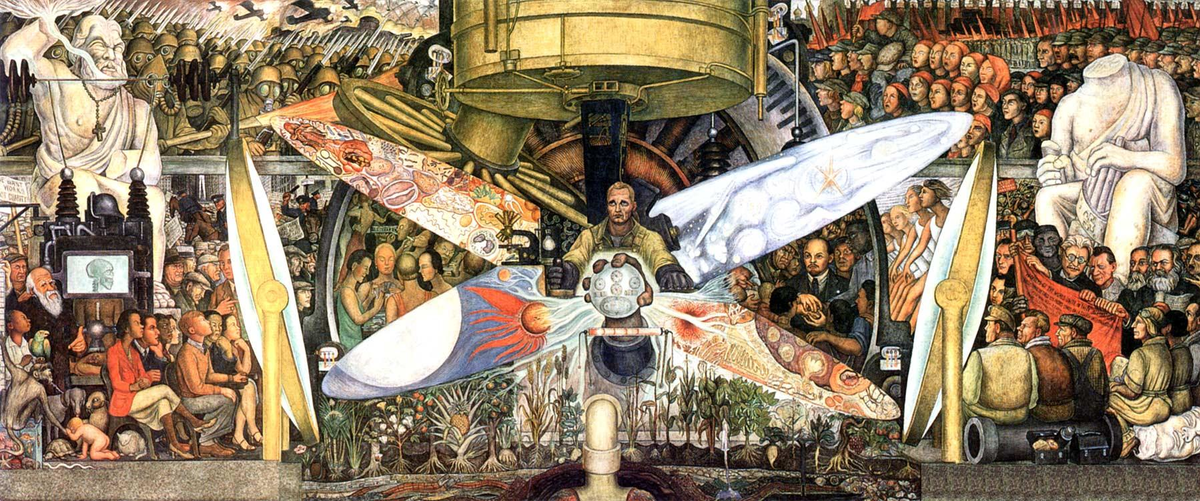
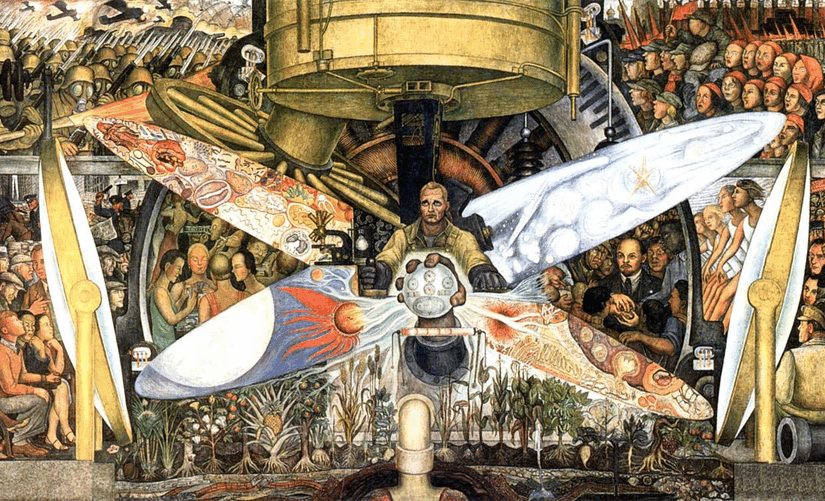
On the west wall of the same floor of the Palacio de Bellas Artes is Rivera’s mural “Man, Controller of the Universe”, originally painted at Rockefeller Center but destroyed because it included an image of V.I. Lenin.
“[T]he dissociation of spatial and temporal and the social actualization of that dissociation can only be a late development, a corollary of which has been the split between representations of space and representational spaces. It is by taking representational spaces as its starting-point that art seeks to preserve or restore this lost unity.”