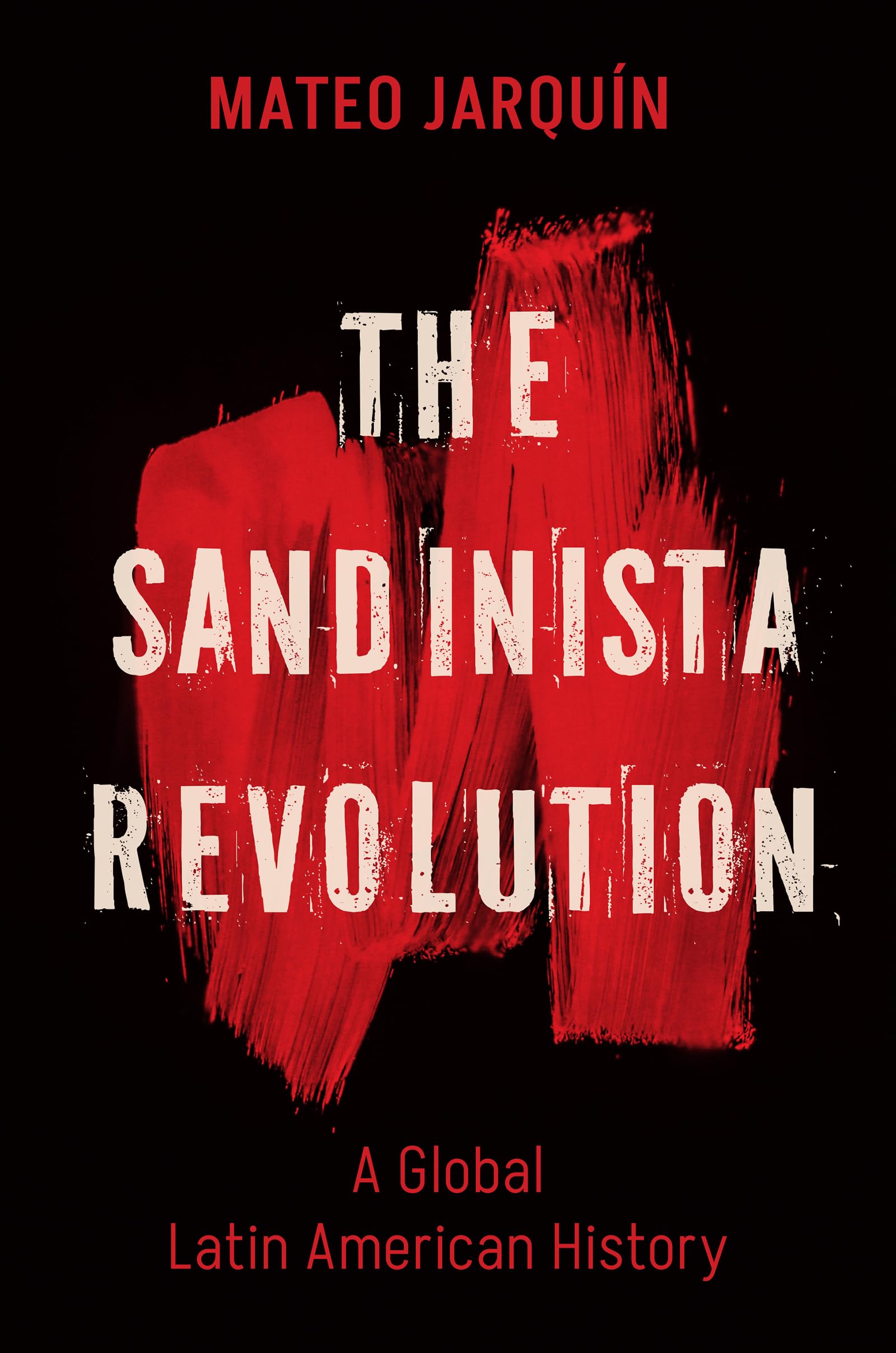
My review of The Sandinista Revolution: A Global Latin American History, by Mateo Jarquín, has appeared in the American Historical Review. Here’s an excerpt:
Mateo Jarquín. The Sandinista Revolution: A Global
Latin American History. University of North Carolina
Press, 2024. Pp. 336. Paper $29.95.
Every revolution is global in both its origins and its repercussions, and Nicaragua’s was no different. In The Sandinista Revolution: A Global Latin American History, Mateo Jarquín emphasizes the regional over the global, placing Latin American diplomacy at the
center of the Nicaraguan Revolution and the counterrevolutionary struggle it set off. In foregrounding Latin American diplomatic efforts first to remove the Somoza dictatorship and then to manage the ensuing regional conflict, Jarquín contends that “the view from
Washington can obscure the Nicaraguan Revolution’s global dimensions” (2). The book draws on thorough research in multiple archives across Latin America and
interviews with many Nicaraguan and other Central American diplomats, reinforcing the importance of regional diplomacy in Latin America’s Cold War.
A key question during the revolution and afterward has been not whether the Nicaraguan Revolution should be considered global but its polarity on the globe itself: Was the revolution primarily a North-South or East-West conflict? Jarquín argues that in its earliest stages, the Sandinistas embraced the East-West polarity of socialism versus capitalism even as they couched their demands in the North-South language of self-determination. Over the course of the decade following the successful revolution, the language of self-determination and democracy would crowd out the aspiration for socialism as the revolution moved away from its most radical demands for social transformation. International
diplomacy played a key role in the transformation of revolutionary priorities, as Sandinista leaders fought for survival by shifting the revolution’s goals in response to
both internal and external pressures.
Earlier scholars like Reagan administration official Robert Kagan, author of A Twilight Struggle: American Power and Nicaragua, 1977–1990 (1996), also emphasized the centrality of diplomacy to the Sandinista Revolution, while holding that the primary US goal in funding the Contra war and Central American death squads was democratization. Jarquín dubs the Cold War in Nicaragua “crepuscular” instead of “twilight” as Kagan does, reframing the neoconservative narrative that US foreign policy brought democracy to Central America by including other diplomatic actors in intermediary roles (214). While Kagan argued that
US military and economic pressure forced Nicaragua to democratize, Jarquín frames Sandinistas’ compromises with international pressure as Latin American diplomatic successes. For instance, the 1979 Puntarenas plan that paved the way for Sandinista victory—calling for free elections, the preservation of private property, and the maintenance of Somoza’s National Guard—“represented a surprising rebuttal of North American
hegemony with little precedent in the history of the hemisphere” (72). As evidence of this rebuttal, Jarquín cites Carter National Security Advisor Zbigniew Brzezinski’s “despondency” at Cuban influence in Nicaragua. However, other Carter officials, such as Undersecretary of State Viron Vaky, who helped broker the deal, celebrated it as a harbinger of moderate policies to come, in which even a victorious Sandinista movement would
be constrained by its ties to the United States and its own allies among social democratic governments in Europe and Latin America even if it sought greater assistance from the Soviet Union.
Jarquín’s narrative shows that both views had elements of truth: The Soviet bloc did provide training, advice, and military assistance to the Sandinistas, while even Cuba encouraged moderation of revolutionary aims. The Sandinistas’ other allies, especially Latin American
and Western European social democracies, proved even more stringent in their demands for compromise from the Sandinistas, despite the movement leadership’s own generally Marxist-Leninist preferences. The onset of the Contra war brought new efforts led by Latin Americans to negotiate an end to the conflicts breaking out all over the region. The Contadora process that grew from Mexican President López Portillo’s efforts at mediation
showed that Latin American diplomacy itself had many faces given that Central America was divided between US clients—Guatemala, El Salvador, and Honduras—and less clearly aligned states, Costa Rica and Panama, which shared few goals and were riven by civil conflict. Through diplomatic efforts, the Sandinistas would eventually win recognition as legitimate political actors against the express wishes of the Reagan administration,
but that very recognition helped cement the shift of the revolution’s own polarity from an anticapitalist to a pro-democracy movement. A key moment in the narrative came when the 1984 Contadora treaty negotiations collapsed because of pressure from Washington. Despite the many compromises the Sandinistas made with the demands of allies and the expectations of the United States, Jarquín asserts that recognition brought by even failed negotiations signified a setback for US hegemony. This meant that “Washington’s ‘East-West’ thesis was losing the war of ideas against what Alan García called the ‘thesis of continental sovereignty’” (160). Given that the Sandinistas, too, had once embraced the aforementioned thesis, this diplomatic victory in the war of ideas implies a major capitulation in the aims of the revolution itself, rendering it pyrrhic at best. There is no single point at which the Sandinistas traded socialism for democracy, but by the time of the Esquipulas accords, the Sandinistas had shifted their sights from the East-West conflict over capitalism and socialism to the North-South struggle for sovereignty and self-determination in response to threats from the United States. Was such a shift a victory for Latin American diplomacy, or a reiteration of the “view from Washington” from a different vantage? Jarquín’s work is an
important contribution to debates over whether Latin America’s post–Cold War neoliberal transformations grew from internal pressures or external forces.
Twilight leads to darkness in the book’s final pages. Though diplomacy had helped to “catalyze post–Cold War processes of regional integration, multilateralism, and multipolarity in the hemisphere,” one diplomat admitted that “‘nobody ever said that Esquipulas would solve the problems of inequality and misery’” (228, 234). Jarquín states that by those terms, diplomatic efforts were “rather successful,” bringing about the 1990 elections that the Sandinistas would lose and a decade of neoliberal restructuring. However,
in post–Cold War Nicaragua, the Sandinista party transformed under Daniel Ortega from a vibrant revolutionary experiment into a “family dictatorship” analogous to Bonapartism or Stalinism, leaving the country with neither socialism nor democracy (232). If the Sandinista Revolution was the sunset of the Cold War, Nicaragua still awaits its dawn.
David Johnson Lee Adams State University